- Country Belgium
- Region Meuse Valley
- Website Visit website
- Instagram Visit profile
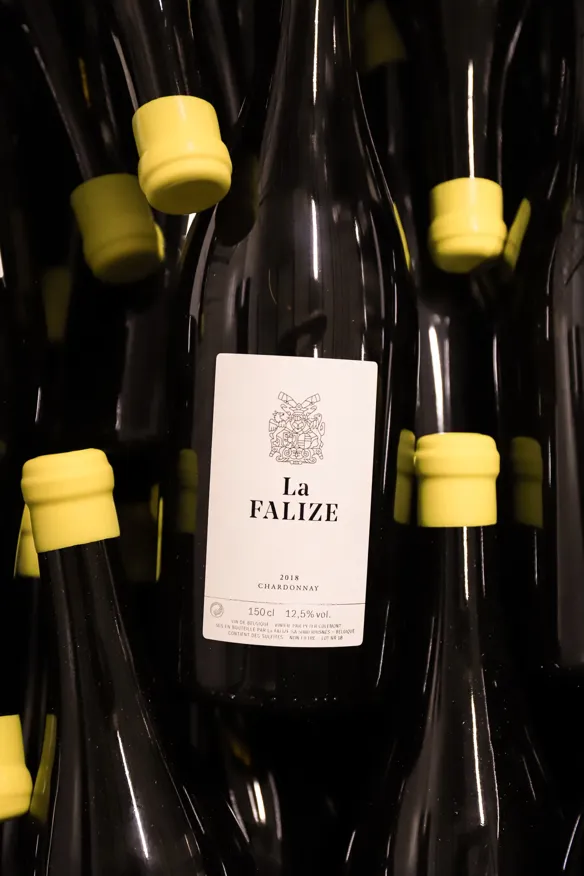
Belgium is increasingly coming to the forefront of premium viticulture. There is a rich history of winemaking in Belgium dating back to Roman times, in particular in the Meuse region, where La Falize is located, when a large part of what is now France and Belgium was part of Gallia Belgica.
After a long gap, viticulture flourished at all monasteries throughout the area and peaked in the Middle Ages. Viticulture came to an abrupt halt in the early Nineteenth Century owing, above all, to the volcanic eruption of the Mount Tambora in Indonesia in 1815. This lead to 'the year without summer' in 1816 when an ash cloud prevented vines from ripening and as a result were uprooted in favour of cereals.
But today, some two centuries on, winemaking in Belgium is strongly renascent. At the forefront in terms of quality is La Falize, established in 2012 on his organically farmed family estate in the Meuse valley by Frédéric de Mévius and the crack duo of winemaker Peter Colemont and Sylvain Pellegrinelli (formerly Chef de Culture at Domaine Leflaive and now at Domaine de la Romanée-Conti).
The name La Falize, which finds its origin in ‘cliff’, refers to its location at the top of a rocky escarpment overlooking the Houyoux river. The terroir here is clay-loam soil with patches of slate, making it an ideal home for Chardonnay as well as Pinot Noir and Savagnin. The vineyards are biodynamically farmed. Frédéric de Mévius was drawn to biodynamic winemaking through the pioneering establishment of biodynamic vineyards in the 1980s by among others Nicholas Joly at the Domaine La Coulée Serrant in the Loire and Anne-Claude Leflaive in Puligny-Montrachet.
La Falize received its Demeter biodynamic certification in 2019. Biodynamic farming views the vineyard as a holistic system taking into account the well-being of the entire ecosystem and promoting soil health and biodiversity. The intensive manual labour required for biodynamic farming means it is only adopted by small and specialist domaines with a long time horizon. There are only 64,000 ha of biodynamic vineyards planted worldwide and for good reason: it takes significant dedication, time and investment to be successful.
La Falize is in a fortunate position for climate change, with temperatures reminiscent of Burgundy in the 1980s and 1990s resulting in wines with a natural alcohol of 12.5%. It is often said that the best wines are made on the edge of where the grape can ripen and this is certainly the case for La Falize as the wines are laser-poised. Stylistically, the Chardonnay most closely resembles a Puligny-Montrachet with its combination of tension, impressive fruit concentration yet lightness of touch and long saline finish. The wine is aged in François Frères oak with fine grain and medium toast with little bâttonage and extended lees ageing. The long, saline finish only confirms its class. It has a lightness and brightness of taste that is its own and incomparable.
The combination of La Falize’s long term commitment to organic agriculture and sustainability as well as the desire to create one of the best wines in the world, its exceptional terroir and its highly experienced team makes for a hugely powerful combination. La Falize has won recognition in the Financial Times in 2024. Perhaps more impressively, it has won recognition in the French heartland of biodynamic heritage as two of its wines received accolades in the definitive bible: La Revue du Vin de France in 2025 (one on the cover) as well as in Les Echos,which featured the Chardonnay as its top choice of white wine for autumn 2025.